
Feast of Plenty: Bullet Points and Author Notes
Andrew writes a poem, shares some links, and explains a flood.

Welcome to another round of behind-the-scenes Substack footage!
Today, I’ll share a bit more about the writing process for my essay, “Collecting Pictures from a Flood.” As I alluded to in the tag line for that post, it was the first time that I can recall making myself cry from a line that I wrote. That’s not a boast or a confession, just a weird fact.
Now the tears have dried, and I’m blushing from these lovely comments—thanks, Ava Berlin and Mélina Magdelénat:
But before that, here are the cool things I encountered in the world since my last post:
I wrote the following poem as a response or homage to Andrew Arndt’s listy poem of gratitude. Here are my looted phrases:
For What It’s Worth
I too love
the songs
of Aspens
and chimes
and Max Richter
on cello,
the way we talk
for Maybe
our goldendoodle
who purrs
when you pet
her just right,
the gift of laughter,
the surprise of a
sentence that says
a thing
exactly as it
must be said.
Praise to the muse,
this love that
purrs in the trees,
in the poem
of our before,
now, and ever after.
Dr Poonam Desai convinced me to go to bed at a regular time and not eat after nine o’clock at night. Does it count if that regular time is at one in the morning?
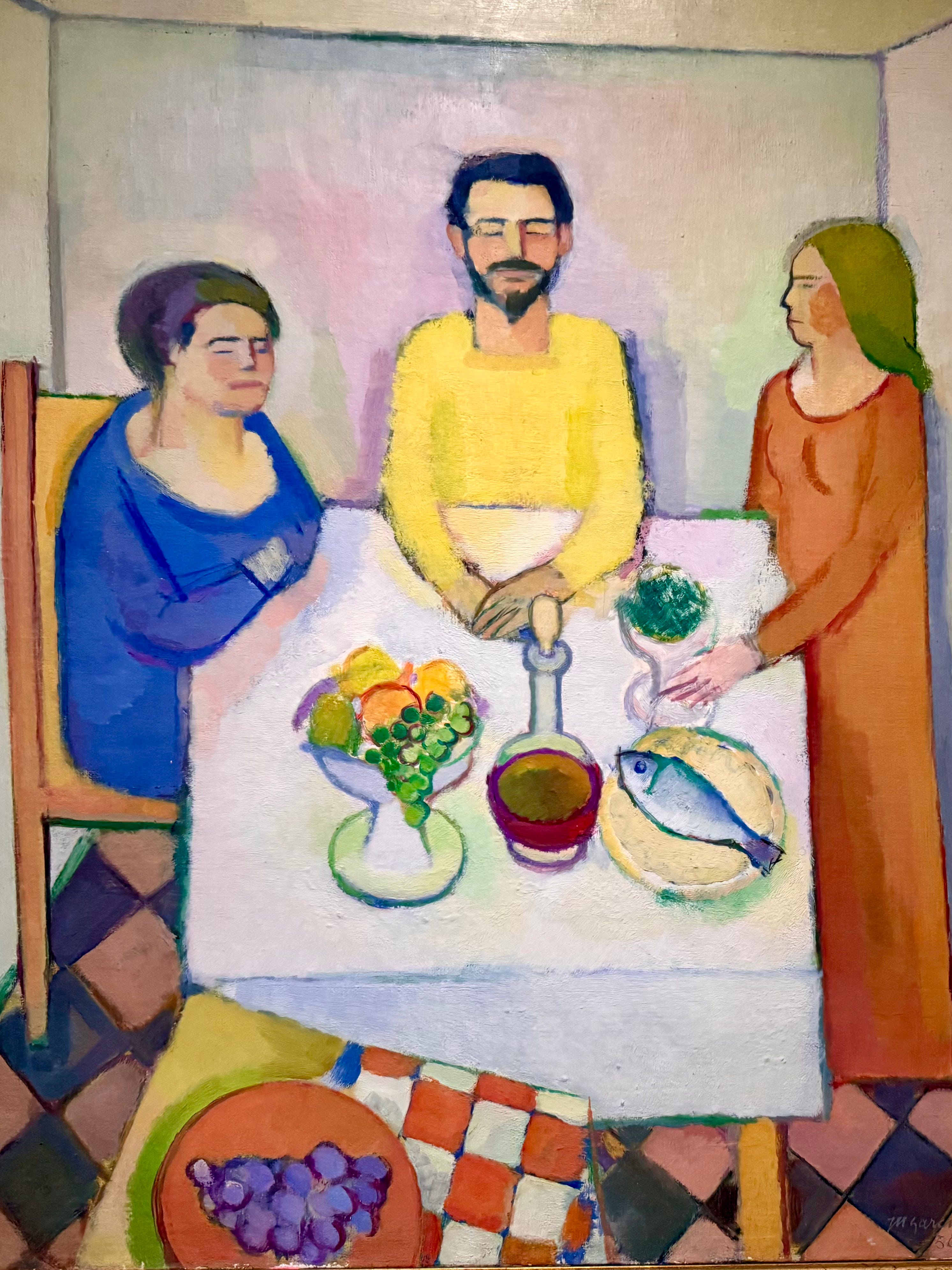
Amanda gestures to the importance of reading Scripture in context. We can and should interpret Scripture for the present moment, but we should be cognizant when we’re transporting it into the yellows and blues and oranges of our present day—like in this painting I photographed in the Museo de Montserrat, “In Martha and Mary’s House” by Josep Maria Garcia Llort.
mshedden reminded me of the haunting end to my favorite Advent novel, Cormac McCarthy’s The Road: “Once there were brook trout in the streams in the mountains. You could see them standing in the amber current where the white edges of their fins wimpled softly in the flow. They smelled of moss in your hand. Polished and muscular and torsional. On their backs were vermiculate patterns that were maps of the world in its becoming. Maps and mazes. Of a thing which could not be put back. Not be made right again. In the deep glens where they lived all things were older than man and they hummed of mystery.” I’ve devoted 4.7 percent of my posts here to The Road; here’s one:
In Orlando, the SBC voted to ban women from preaching. In Seattle, our church celebrated fifty years of ordination for Pastor Nancy Winder, now one of our congregants. Paul Elred drew my attention to this contrast and “some of the countless women throughout church history who proclaimed the gospel of Jesus Christ: Mary Magdalene, Priscilla, Phoebe, Junia, Lydia, Hilda of Whitby, Hildegard of Bingen, Katharina von Bora Luther, Sunday school teachers, Bible study leaders, professors, deacons, pastors, and bishops. God used, and continues to use, all of these women and more to teach and preach and embody the good news of God’s love that knows no boundaries or limits and will not be constrained by churches or votes.”
The NYC subway as jazz: “Every dot is a real subway train. Eight hundred of them, give or take, form a small jazz combo . . . that has been playing without pause for over a hundred years. On the platforms they are hot, screaming, full of complaint. This is the music inside the noise.”
I watched Hamnet on the plane. Alone. Erica wouldn’t watch it with me because she said the trailer made her cry. I couldn’t tell whether it was profound, pandering, or both, but Jessie Buckley was enigmatic.
The people in my book club likely think I’m insane. I’m having us use the Condorcet method to determine our book selections. That majority-wins method originated, of course, with Marie Jean Antoine Nicolas de Caritat, the Marquis of Condorcet, who has been called the “last witness” of the Enlightenment. We picked What We Can Know by Ian McEwan. My two suggestions, The Emperor of Gladness and On the Calculation of Volume (volume 1), came in last.
And lastly, we met our older teens when they were in foster care. In its coverage of the first lady’s policy efforts related to foster kids, the NYT writes this: “There are more than 300,000 foster youth in the United States, and the population has some of the most dismal social and economic outcomes, namely high rates of homelessness and unemployment.” And that’s not to mention the high rates of suicide—Angela Tucker at The Adopted Life has pointed out that the suicide rate among adoptees is four times that of other people.

Our adopted teens are not homeless or unemployed or suicidal. In fact, my most recent post started by highlighting the fact that our adopted son graduated high school last week. That was an extraordinary accomplishment,