

Bookends and Subscriptions
Andrew reveals another job loss and potential subscription changes

* * * If you want to skip to the bit about subscription changes, go here; the gist is that if you like what you read here and can spare some coin, please consider a paid subscription. If you want to skip past that to hear the tea about my wife losing her job, go here. * * *
I began this Substack in early 2025, still reeling from the January inauguration of our firer in chief. On day one, that man, the president of the United States, made it his priority to toss me and thousands of civil servants from our jobs. And based on my experiences at the VA, I can say that he and his minions seemed to have a unique appetite for the devastation of medical research.1
The details of my job loss are complicated, but for the first time since high school, I was underemployed and facing the possibility of unemployment. In the months that followed, I worked part-time on some writing and editing gigs, and I began to think about what it might look like to seize the job loss as an opportunity. Could I reinvent myself vocationally? And if so, what would that look like?
For a few minutes, I thought about making pizzas.
The closest I’ve come to a food service job is a short stint in a factory where my main responsibility was squeezing piles of imitation crab goo together as they passed me on a conveyor belt. But the shadow of opportunity haunts my periphery, as my dad and his business partner own a few pizzerias in Oregon. Perhaps I could build off that time at age six when I stood at the Pietro’s Pizza concession tent at the Bite of Seattle and attempted to sell pizzas. Perhaps I could leverage the time I was a Pietro’s model into a nepotistic appointment in management.

Then I thought seriously about writing.
L.A. Witt, a fellow graduate of my high school, graciously shared about her experience scraping together a successful career as a novelist. She didn’t entirely scare me off from the idea, but I had the sense that I could not do this—I could not get by on simple stories of family and fatherhood. To really make a living writing poetic essays about my life, I would either need a new, more famous life or to mainline a buzzing current of good luck.
Instead, I took the small step of starting this Substack.
My plan at the time was to make my writing here completely free until I reached either one hundred free subscribers or ten generous souls who pledged to someday pay a subscription fee. That hasn’t happened yet, but a couple of factors have made me antsy and inclined to toggle on paid subscriptions earlier than I initially planned.2
So here, I want to describe exactly what I’m planning to do and why I’m doing it and to then solicit your feedback.
What Will Happen When I Turn on Paid Subscriptions
I write and share my writing because I enjoy it and because I hope to elicit some sense of truth or beauty that reaches beyond me and the particulars of my story. That’s a lofty goal, I think, and I get that there are hundreds of thousands of other writers out there who aspire for that same alchemy and who may work the metal just right for you and your soul.
I am honored that you are here, even if you cannot or will never pay, and so if I make a change to permit paid subscriptions, I hope to continue making most of the content here free. I also plan to keep the same rhythm of posts—one every one or two weeks.
This, I guess, is different than the normal way of capitalism. It’s a gentler shade of moneymaking in which I hope to incentivize paid subscriptions through your appreciation and concern for my personal story rather than the usual model of scarcity and competition.
Nevertheless, I may experiment with different ways of making paid subscriptions special. This may mean occasionally writing something only for paid subscribers. It may mean adding a paywall for older posts or any posts that get published elsewhere. It may mean writing each of my biggest paid subscribers an ode or hosting a Q&A in which my seven-year-old answers all of your questions about life and Komodo dragons. It may mean nothing.
In other words, there may be no direct benefit to paid subscribers, but I will see your goodness and feel tremendously grateful.
Why I’m Doing This
I have three reasons for potentially making this change now: (1) to increase readership, (2) to adjust to the external publication of one of my essays, and (3) to ever-so-slightly help address an income issue for our family.
First, I’ve read that Substack is more likely to funnel readers your way if you have paid subscribers. So your paid subscription could help me beat the algorithms. You could also help me by directly sharing my writing with people you think may be interested.
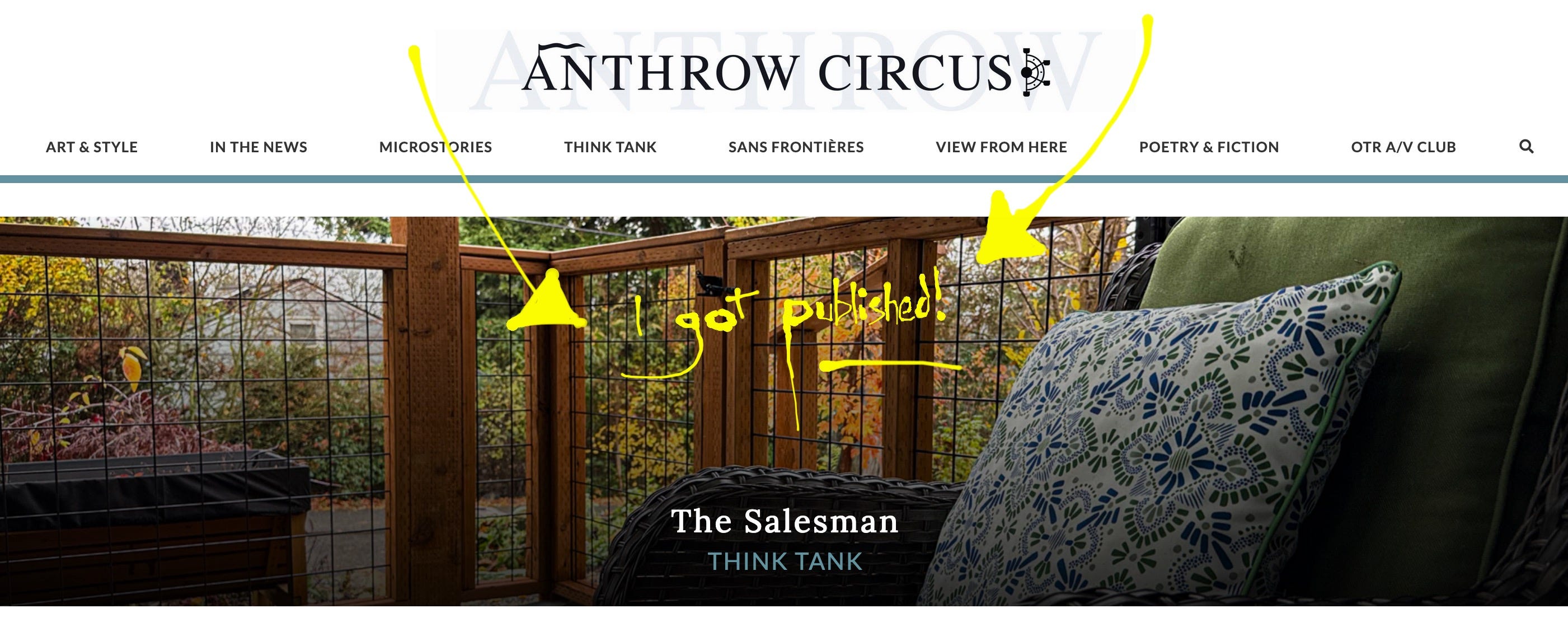
Second, I just got one of my essays here published at Anthrow Circus! It’s the one about the Quantum fiber salesman and foster care.3 I think I should make the piece exclusive to Anthrow Circus and paid subscribers here.
Third, my wife essentially lost her job in November.
If you’ve got a low tolerance for reading about ugly people, just know that our finances have taken a hit and that if I toggle on paid subscriptions it’s because every little bit helps. Preschool in Seattle is expensive!
If you can handle workplace drama, here you go:
For five years, my wife, who I’m here calling Heather, has been working at an attention deficit hyperactivity disorder (ADHD) clinic in Seattle, where she specializes in performing intake evaluations and assigning diagnoses. Her supervisor has consistently praised her for her clinical excellence, and the management team recently incorporated her feedback in revisions to the company intake policies and procedures. Earlier in the year, they even discussed the possibility of having Heather shadow her supervisor and complete clinical supervisor training to lead the intake program, but they concluded there was no immediate need for such a position.
After a slow summer, Heather had a full slate of intakes in September and early October. Things seemed like they were going well, though in October she was surprised to discover that they had hired a new intake supervisor after all.
Then, suddenly, without any communication from the owner, her current supervisor, or this new supervisor, she stopped being scheduled for work. For the first week or so, she wondered whether there was a big dip in intakes or some kind of scheduling issue, so she asked her longtime supervisor to look into it.
About a week later, in a meeting that her new supervisor ghosted, the longtime supervisor informed Heather that all of her hours were being taken by her new supervisor, so he could build his caseload. Let me just emphasize that—the man who was supposed to lead and support Heather was taking all of her work, not just that week but on the schedule through the end of the year. And with no warning, no explanation.
Heather emailed the new supervisor to discuss the situation. He never replied.
Finally, several weeks later, the owner of the company had a Zoom call with my wife. The owner was curt and never acknowledged the effect on our family of slashing Heather’s hours, especially during the holidays. She never acknowledged their astounding lack of communication. She gave no reason why Heather was singled out, offered no hope for additional hours, and never directly spoke about Heather’s future with the company.4 And when Heather said that she believed she’d been treated poorly and unethically, the best the owner could do was to say, “I’m sorry you feel that way.”
During the entire call, Heather’s supervisor for the last five years never said a word.
Soliciting Feedback
In college, I worked for a market research company, so I like survey questions. If you are also into survey questions, want to help me navigate this potential change, or just want to see the super fun survey questions I drafted, check this out. If you don’t like surveys but have thoughts on this post, leave a comment below.
By the way, one of the perks of working for that market research firm was that they paid me to fly to California and distribute surveys on Amtrak trains. For a cheap college kid like me, the use-it-or-lose-it travel per diem was a minor miracle, particularly on those nights late in a trip when I had more per diem money than I knew how to spend. I remember strolling Mission Beach with a smoothie in one hand and a shake in the other—the bliss of the indecisive rich.
If you’re crazy enough to support me at the upper limit, you will give me that same grin.
Bookends
By now, the reason I titled this post “Bookends and Subscriptions” is likely obvious. The year began with the president trying to can me and ended with a more personal yet passive-aggressive job loss.
I would love to bookend the year with some new paid subscriptions and reach my original goal of ten.
But despite the slow growth here or the roller coaster of economic challenges for my family or the way our country has been carpet-bombed by the present administration, this has been a great year.
I write this from a marshmallow of a bed in Edmonds where Heather and I have luxuriated in two nights away from the kids.

We’ve had a chance to look at art and eat good food and reflect on how lucky we are to have found one another and a thousand other blessings. As I hope I’ve communicated elsewhere, we’ve had a year of healing, as we continue to mend our hearts after the departure of our teenagers. And we’ve had a year of ordinary trials and triumphs as we get to watch our young boys make friends and learn and develop their own delightful idiosyncrasies.
I wish you a year like ours, but with a triple helping of vocational peace.
I’m still dumbfounded by this. I can understand (though not necessarily affirm) a libertarian who gleefully hacks away at federal programs. But I cannot understand how specifically hampering government-sponsored research benefits anyone but the Grim Reaper. Stupid is an unimaginative, insulting word, yet it seems like the best one to apply to the administration’s strategy, particularly in regard to the effects I’ve personally seen in dementia, military injuries, and cancer.
As of today, I have 92 followers, 73 free subscribers, and 7 paid subscriber pledges.
The story of the publication of “The Salesman”:
Last month I attended a party with a friend in which there was a delicious taco, dessert, and Swedish drink bar. After getting our fill, we partyers had been asked to bring something to share, so I was looking here for something relatively short and upbeat. As guests went around the room and offered their contributions, I started to get nervous. Lots of people shared stories about their activism efforts, and Heather and another guest shared beautiful poems they had discovered, but no one—not a soul—read from their own writing.
I worried that I might downshift the vibe, but it wound up being fine. More than fine, I guess, as an editor happened to be at the party, and she asked if she could publish the piece in Anthrow Circus.
So hooray for parties! Hooray for doing things that make us anxious! Hooray for editors and small publications!
I think this is because they didn’t think Heather had any regular clients. That is, most of the clinical providers at this agency do a few intakes and have a roster of clients, whereas Heather developed a niche of primarily doing intakes. That means that unlike the other providers, if Heather responded poorly to her hours being cut and left the company, they would be less likely to lose clients who might follow her. In fact, the owner seemed surprised when Heather sought clarification about her one client.
Andrew---So sorry Heather lost her job. Tough times you two have been through. How do I support you and this substack?